

- November 9, 2026
- Alaa Mostafa
- 0
Aluminum Manufacturing ERP Solution for Production & Quality Control
An aluminum profile passes through four to six stages before it
ships: extrusion, ageing, sorting, anodising or powder coating, then
packing. Most plants only see it in stock at the end. Here is how SAP
Business One changes that.
Aluminum extruders in Egypt work with tight margins, volatile metal prices
and demanding export customers. Yet many still track billets, scrap and
finished profiles in spreadsheets and paper shift reports. The result: scrap
is estimated, quality and production argue over counts, and true cost per
ton is known only weeks later.
At BE ONE we built an aluminum industry solution on SAP Business
One from a process blueprint validated with a leading Egyptian aluminum
producer. Below are the five ideas that make it work.
1. Treat every stage as stock
The foundation is the item design. Instead of one finished item, each
stage gets its own stock item: extruded, heat-treated, and finished (mill
finish, anodised or painted). Finished codes carry profile, length and
colour; semi-finished codes carry profile and length and link to the die
study number.
Foundry
billets
Press + Saw
extruded
Ageing Oven
heat-treated
Finishing
MF · anodised · painted
Packing
batch
Each stage has its own production order and warehouse. Planners see
exactly how many metres of each profile sit between the press and the
oven, and Finance can value that work in progress.
2. Let the press tell you the real yield
A dedicated press form captures what operators already know: shift,
press, die, billet count and length, alloy, butt-end length, weight per
metre, downtime and its reason. On save, SAP Business One calculates
billet consumption and scrap per order, issues the billets automatically
and receives butt-end and saw scrap into a scrap item.
Yield stops being an estimate. It becomes a number per press, per shift,
per die.
3. Make quality the only gate into stock
Production records output; quality inspection posts the receipt. At
every stage QC loads the orders recorded by production, confirms or
corrects the count, and posts good quantity to the next warehouse.
Rejects go to a scrap warehouse on a separate line, with the defect and
weight recorded.
The rule: nothing moves to the next stage until QC accepts it. This
single rule removes most disputes between production and quality,
and gives management one trusted output figure.
Incoming purchases follow the same principle: an inspection activity with
the permit attached goes to QC, and the goods receipt is posted only
after approval, with lab documents attached.
4. Trace every bar, weigh what you ship
Each finished batch carries 11 attributes, including sales order, colour,
alloy, surface treatment, micron thickness, packing type, gloss, rack,
production date and shift. When an export customer raises a claim, the
full history is one search away.
Because actual weight often differs from theoretical weight, the
weighbridge ticket is recorded against a group of work orders and the
actual weight is allocated by theoretical ratio. Plants with a scale at each
delivery point can weigh per order instead.
5. Connect the plant to people and machines
The same data feeds the functions around production:
- Maintenance: presses and ovens are SAP Business One resources
with weekly and monthly preventive plans, a daily inspection log,
breakdown causes and electricity and gas readings. - Workshop and facades: profiles move to the workshop through an
internal sales order; projects are billed by contract and progress
certificates with advance, retention and stamp-duty deductions. - Payroll and incentives: department incentives are calculated from
QC-approved output, alongside Egyptian payroll, social insurance and
tax.
What changes for the plant
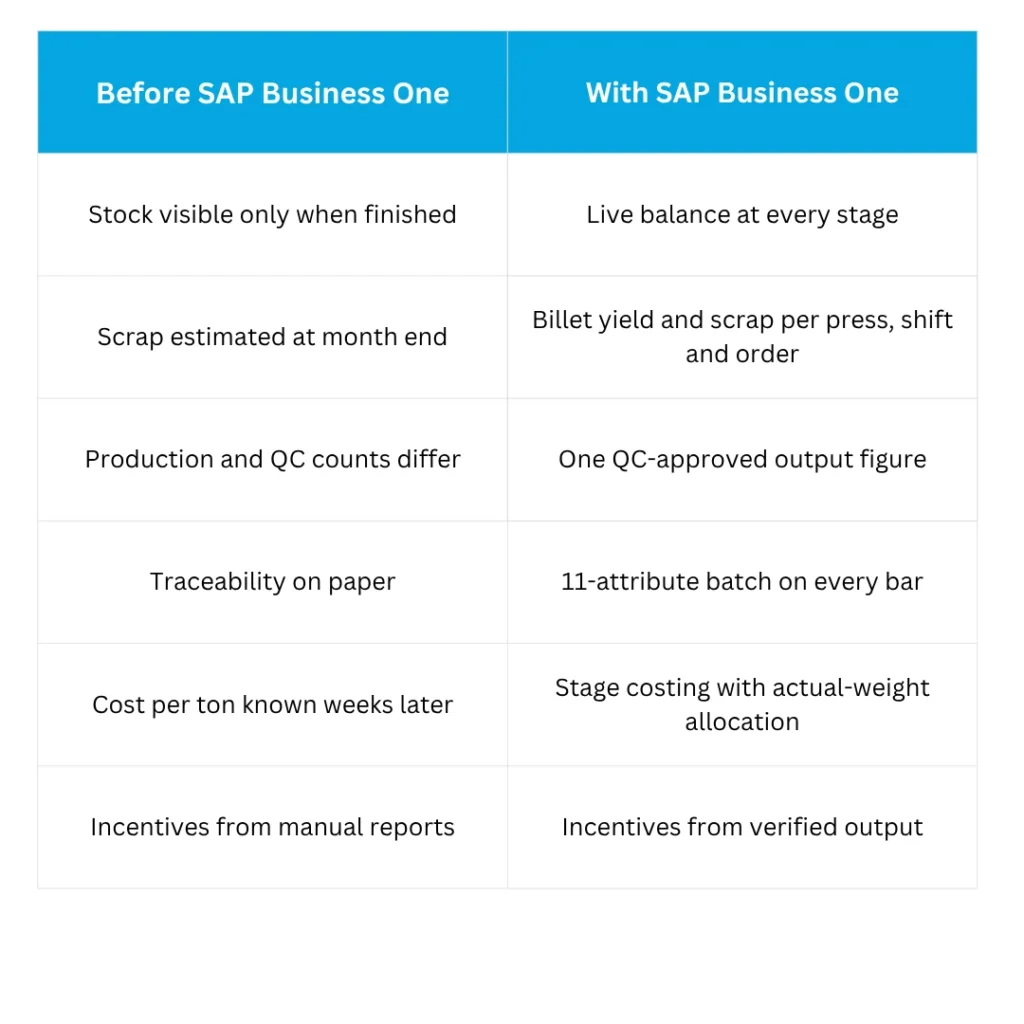
Standard SAP, extended for aluminum
All stock and financial postings stay in standard SAP Business One
documents: production orders, issues, receipts, batches and journal
entries. The aluminum-specific screens are add-ons built on the official
SAP Business One SDK, so upgrades and SAP support remain intact. The
solution runs on SQL Server or SAP HANA, on-premise or in BE ONE’s
cloud.
See the aluminum solution in action
Explore the full scope, add-ons and packages, or book a walkthrough with our consultants.
View the Solution or Book a Demo HERE